Consignment software
Consignment Software That Knows Whose Money It Is
Consignment goes wrong in two places: forgetting whose item it was, and getting the payout wrong. Music Shop Suite keeps the consignor, the agreed split, the floor price, the days on display, and the amount owed on the same record as the item itself — from intake through payout.
- Consignor record with contact, ID, and every item they have with you
- Per-agreement commission split and minimum acceptable price
- Days-on-floor aging so stale stock gets dealt with
- Payout owed calculated from the real sale price, then tracked to paid
- Consigned stock kept out of your owned-inventory valuation
Intake that settles the terms up front
Log the consignor, the item with photos and condition, the asking price, the floor price you may not go below, the commission split, and the end date of the agreement. Both sides know the deal, and it is written down where staff can see it.
- Consignor contact and ID on file
- Asking price and minimum acceptable price
- Split (e.g. 70/30) and agreement end date
The split is calculated, not remembered
If a piece with a 70/30 split lists at $1,800 and sells at $1,650 after a haggle, the payout is figured from what actually came in — not the sticker. No mental arithmetic at the counter, no awkward correction a week later.
- Payout figured from actual sale price
- Your commission recorded as shop revenue
- Discount below the floor price flagged before it happens
Payouts tracked until the money leaves
A sold consignment creates an outstanding payout. It stays on the owed list until you mark it paid, with the date and method recorded — so no consignor ever has to chase you, and you never pay twice.
- Outstanding payouts list with amount and age
- Payment date and method recorded
- Full payout history per consignor
Aging stock you can see
Every consigned item shows how many days it has been on the floor. Sort by oldest and you have your call list: drop the price, renegotiate, or hand it back before the agreement lapses.
Your valuation stays honest
Consigned goods are not your assets. They are tracked and visible, but excluded from your owned-inventory valuation — so the number you give your accountant and your insurer is the real one.
Built for instruments and one-of-a-kind pieces
Consignment software written for generic resale assumes interchangeable stock. Ours assumes each item is unique — serial number, year, finish, condition, provenance documents — because in a music shop it is.
See the workbench before you sign up
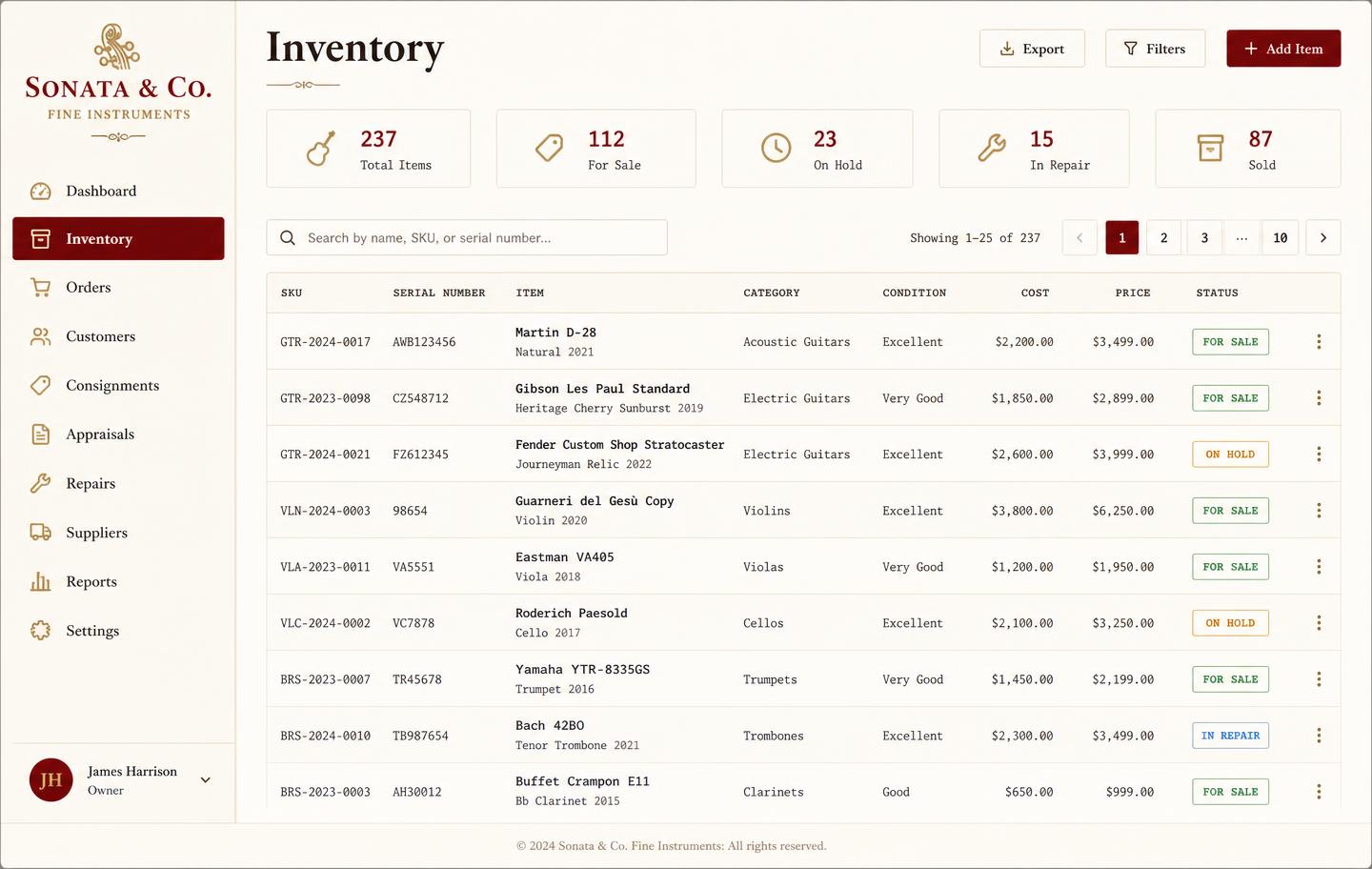
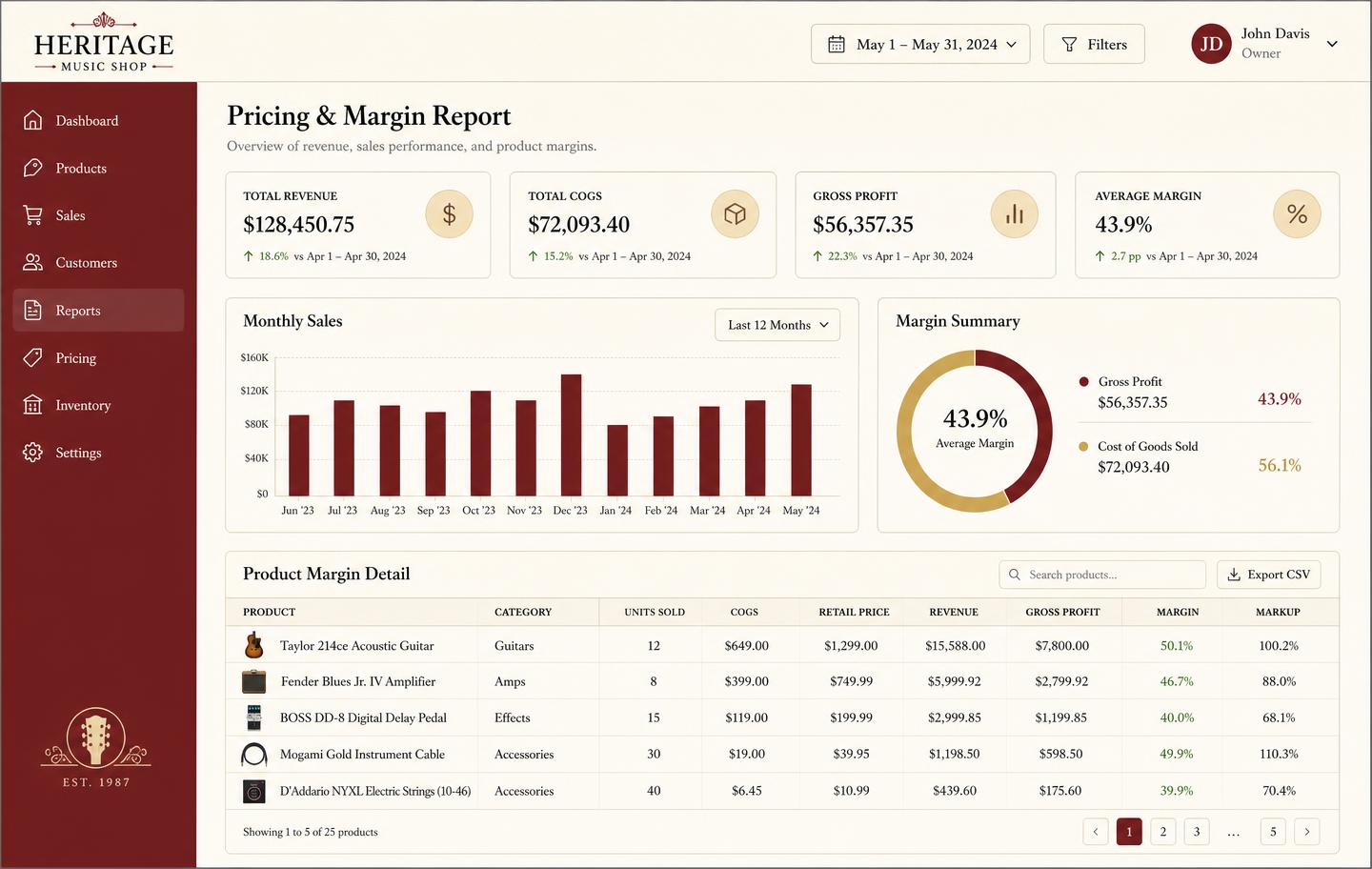
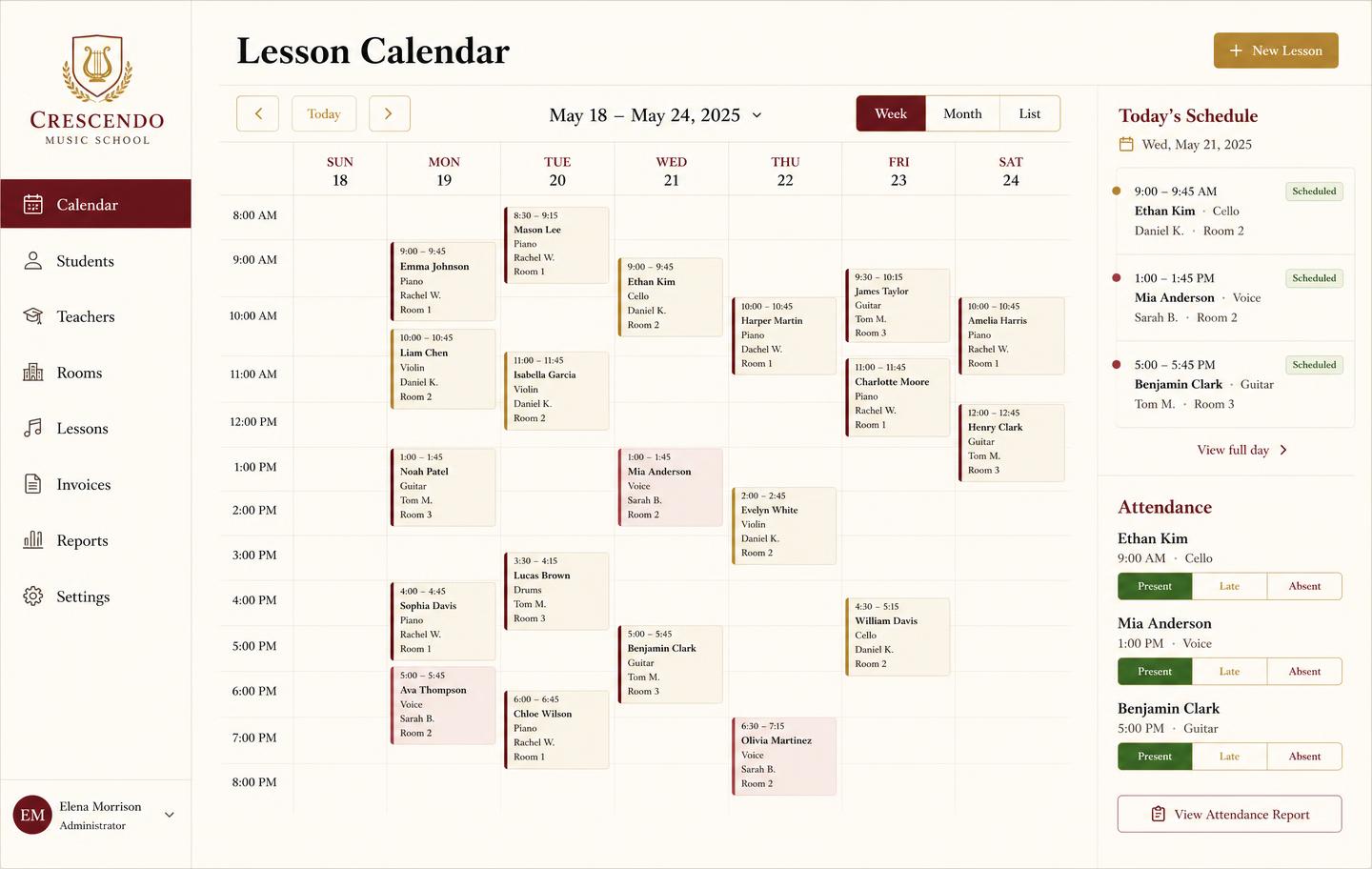
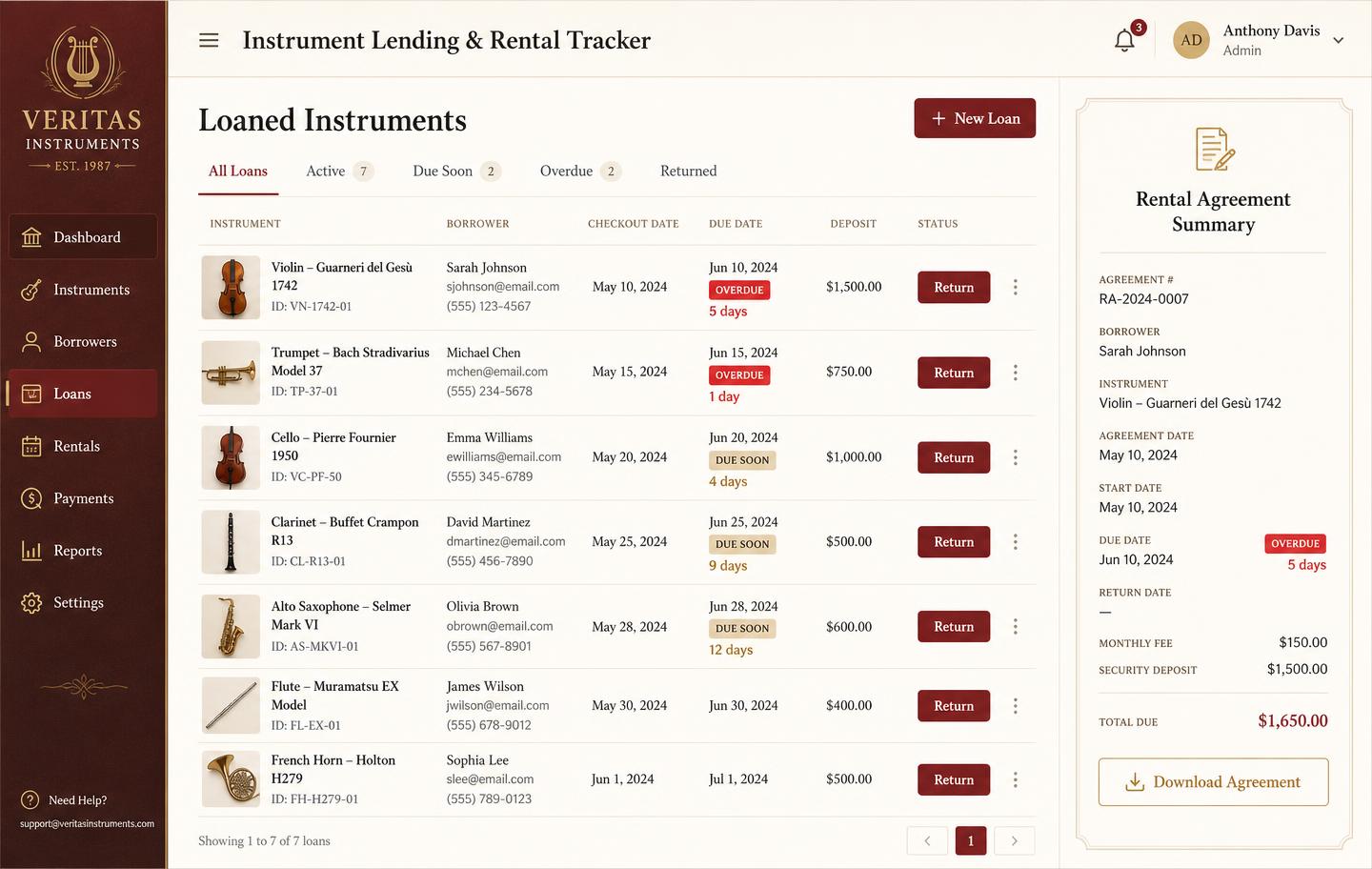
Inventory, pricing, lesson bookings, and instrument lending all live in the same back-office dashboard — no separate apps, no re-keying between them.
Frequently asked
- What does consignment software do?
- It tracks goods you are selling on someone else's behalf: whose item it is, the agreed commission split, the minimum acceptable price, how long it has been on the floor, and what the consignor is owed once it sells.
- Can it handle different commission rates per consignor?
- Yes. The split is set per agreement, so a 60/40 for a regular supplier and an 80/20 for a one-off customer live side by side without confusion.
- How are payouts tracked?
- When a consigned item sells, the payout owed is calculated from the split and the actual sale price, then tracked as outstanding until you mark it paid — with the payment date and method recorded.
- Does it show me aging consignment stock?
- Yes. Every consigned item shows days on the floor, so you can spot the pieces that have sat too long and start the price-drop or return-to-owner conversation before the agreement expires.
Keep exploring the workbench
Every part of the shop lives in one system. Follow the workflow closest to what you are trying to fix first.
- Best music store POS softwareHonest comparison of tills vs the back office.
- Brass & woodwind repairPad and cork jobs, school batches, and loaners.
- Shop bookkeepingProfit by line, stock value, and month-end exports.
- Serial number trackingOne card per unit with full history and audit log.
- Layaway managementHeld units, instalments, and running balances.
- Pricing — $49/monthOne plan, every module, no per-seat surprises.
Sign up today
Run your shop on one workbench — starting today.
$49/month, no contracts, no trial. Import your spreadsheet, invite your team, and have inventory, repairs, rentals, and lessons in one place tonight.