Music store inventory software

Music Store Inventory Software for Serialized Instruments

General retail software counts units of a SKU. A music shop holds objects that are individually different — a 2019 Les Paul with a repaired headstock is not the same asset as a mint 2023, however identical the model number looks. Music Shop Suite tracks stock the way a music shop actually owns it: one record per physical instrument, with its serial, condition, cost, history, and the repairs it has been through.

  • Serial number, condition grade, cost and asking price on every unit
  • CSV import from your existing spreadsheet, re-importable for bulk price updates
  • Photos, receipts and certificates attached to each instrument
  • Live stock value at cost and at retail
  • Immutable change log recording who edited what, and when
  • Repair, rental and consignment history on the same record

Built for one-of-a-kind stock

Two Stratocasters with the same model number are not the same instrument. Each unit gets its own card with its own serial, condition, cost and history — so you always know exactly what is on the floor and what it owes you.

  • Per-unit serial, year, finish and condition
  • Cost and asking price tracked separately
  • Status: in stock, on loan, in repair, sold

Bring your stock in from a spreadsheet

Map your existing columns in a single pass. Re-import the same sheet whenever you want to update prices or quantities in bulk — no double entry and no copy-paste between systems.

  • CSV import with column mapping
  • Bulk price updates via re-import
  • Export at any time to CSV, Excel or PDF

Photos, documents and provenance

Attach hero shots, condition photographs, original receipts and certificates of authenticity to each instrument. Everything stays with the item from intake through to sale — and doubles as your insurance evidence.

Stock value and an audit trail

See total inventory value at cost and at retail in real time. Every edit — price, photo, condition, holder — is recorded permanently with the user and timestamp, which matters for consignors and insurers alike.

The bench and the floor share one record

When a unit goes for a setup or a fret dress, the work order attaches to the instrument. The cost lands on the unit, so the margin report reflects what the instrument really cost you rather than what the invoice said.

Stocktakes that finish in an afternoon

Count against serials rather than guessing at quantities. Discrepancies are specific — this trumpet is missing — instead of a variance figure nobody can investigate.

SKU inventory versus serialized inventory

The distinction sounds academic until the first time you try to work out what a specific guitar cost you.

SKU inventory versus serialized inventory
QuestionSKU-based systemSerialized system
How many do I have?Answered instantlyAnswered instantly
What did this one cost me?Average cost onlyExact cost on the unit
What condition is it in?Not modelledGraded per unit
Has it been repaired?No linkWork orders attached
Who owns it — me or a consignor?Not modelledRecorded per unit
Where is it right now?In stock or notIn stock, on loan, in repair, sold
True margin at saleApproximatePurchase plus refurb, exactly
Insurance scheduleManual rebuildExport from live data

If your stock is strings, reeds and picks, a SKU system is correct and simpler. If it is instruments, it is not.

Why spreadsheets survive so long in music retail, and where they break

A spreadsheet is a genuinely good inventory system for a while. It is free, instantly editable, understood by everyone, and imposes no structure you did not ask for. Most independent shops run one for years and are right to.

It breaks at a specific point, and it is not the point most people expect. It is not row count — spreadsheets handle thousands of rows fine. It is the arrival of the second editor. The moment two people update stock, you have two versions of the truth and a merge problem no shop has time to solve. The classic symptom is a file named with a date, then the same file with 'final' in the name, then a third with someone's initials.

The second break point is history. A spreadsheet stores the current state and forgets everything else. When a consignor asks what their guitar was listed at in March, or an insurer asks what you held on a given date, the answer is not recoverable — because the cells were overwritten. That is the gap an inventory system closes, and it is worth more than the tidier interface.
Cost basis, refurbishment, and the margin that is not real

The most common reporting error in independent music retail is treating the purchase price as the cost. A trade-in comes in at four hundred, sells at nine hundred, and the shop records five hundred of margin. Then someone remembers the setup, the fret dress, the new strings, the case that had to be replaced, and the two hours on the bench.

None of that is exotic. It is normal for used stock, which is exactly the stock independents make their margin on. But if the refurbishment cost is recorded against the workshop as a general expense rather than against the instrument, the per-unit margin figure is wrong in a direction that always flatters.

Attaching work orders to the unit fixes the arithmetic. Purchase price, parts, and bench labour accumulate on the record, and the margin reported at sale is what the instrument actually earned. Shops that make this change routinely discover that one category — often low-value used gear needing setup — has been running at close to zero for years.

Stock ageing: the report that pays for the software

Ask most shop owners which of their stock is slow and they will name two or three items. Ask the system and it names forty. The gap is not carelessness; it is that slow stock is invisible by definition. It does not generate transactions, so it does not appear in any report driven by transactions.

Ageing turns absence into a signal. Group units by days on the floor and the January clearance list writes itself, ordered by how much capital each item is holding hostage. It also changes buying behaviour, because the pattern of what ages is usually consistent and usually surprising.

This is the single report most worth having, and it requires per-unit records to produce. A SKU count cannot tell you that this particular amplifier has been sitting since eighteen months ago, because in a SKU system this particular amplifier does not exist.

What to look for when comparing inventory systems

Feature lists are close to useless for this decision, because every system lists inventory. The questions worth asking are narrower and mostly about the data model rather than the interface.

Does a unit exist independently of a product? Can two units of the same model hold different costs and different conditions? Can a repair, a rental and a sale all attach to the same physical object? Can you export everything you put in, without a support ticket? Is history preserved when a field is edited, or overwritten?

A system that answers yes to those will serve a music shop regardless of how its dashboard looks. One that answers no will require a spreadsheet alongside it within a year — which is the situation you were trying to leave. If you want the comparison written out in full, our inventory software versus spreadsheets breakdown covers the migration path as well as the trade-offs.

See the workbench before you sign up

Inventory, pricing, lesson bookings, and instrument lending all live in the same back-office dashboard — no separate apps, no re-keying between them.

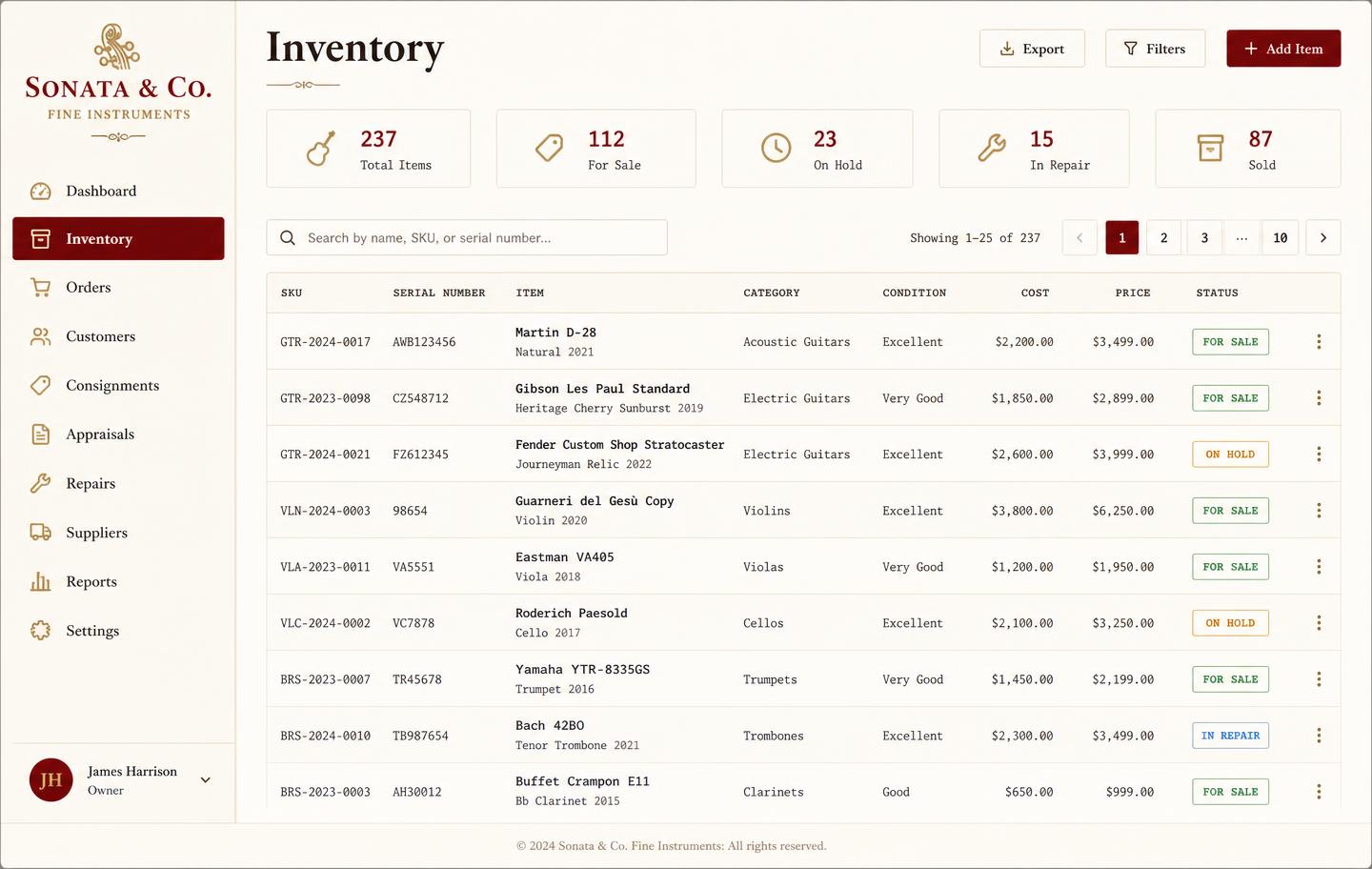
Music shop inventory dashboard listing instruments with SKU, serial number, condition, cost, price and status
InventoryEvery instrument tracked by SKU and serial with condition, cost, retail price, and live status — for sale, on hold, in repair, or sold.
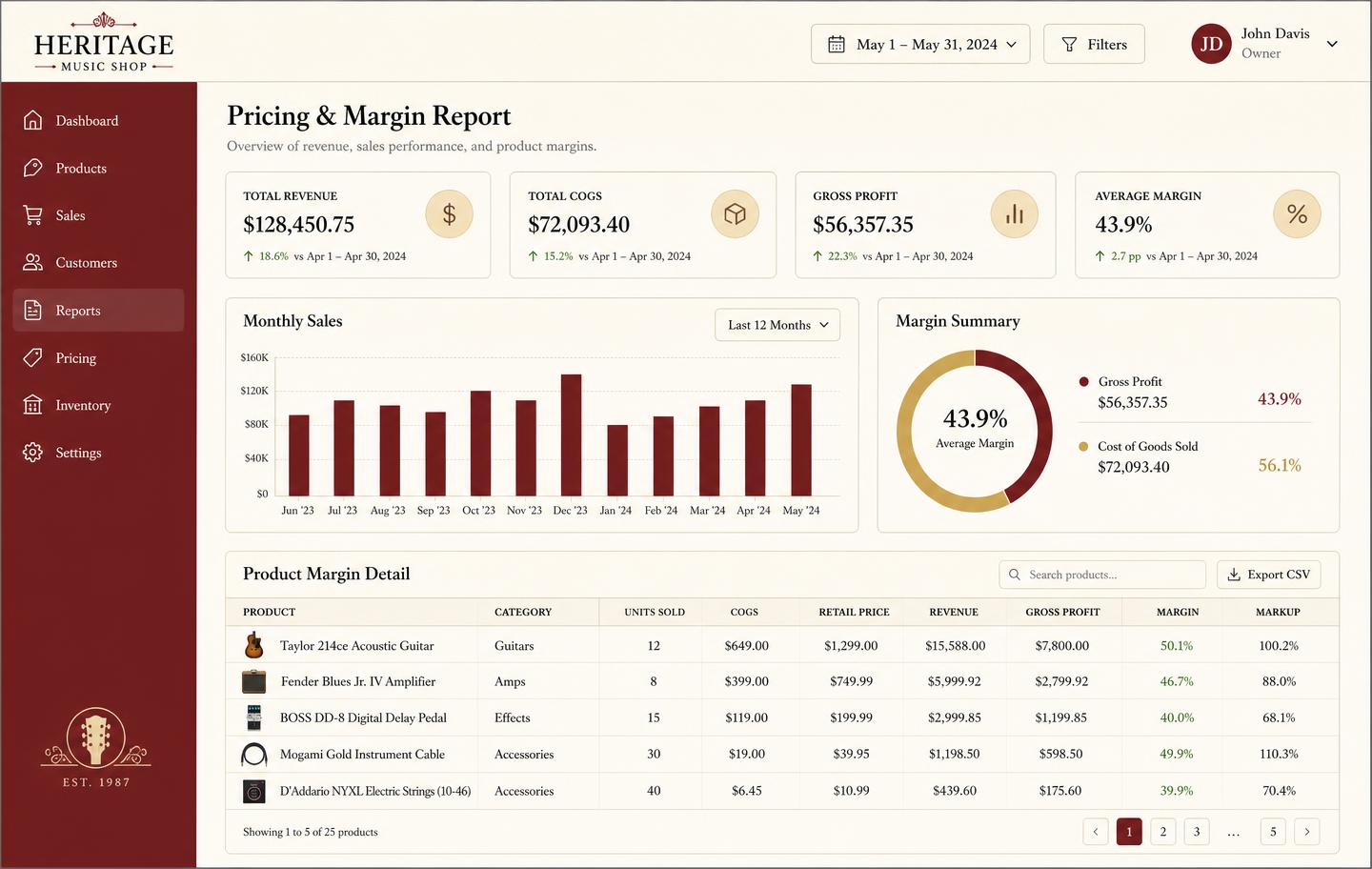
Pricing and margin report showing revenue, cost of goods, gross profit and per-product markup
Pricing & marginRevenue, cost of goods, gross profit, and markup per product so you price from real numbers instead of gut feel.
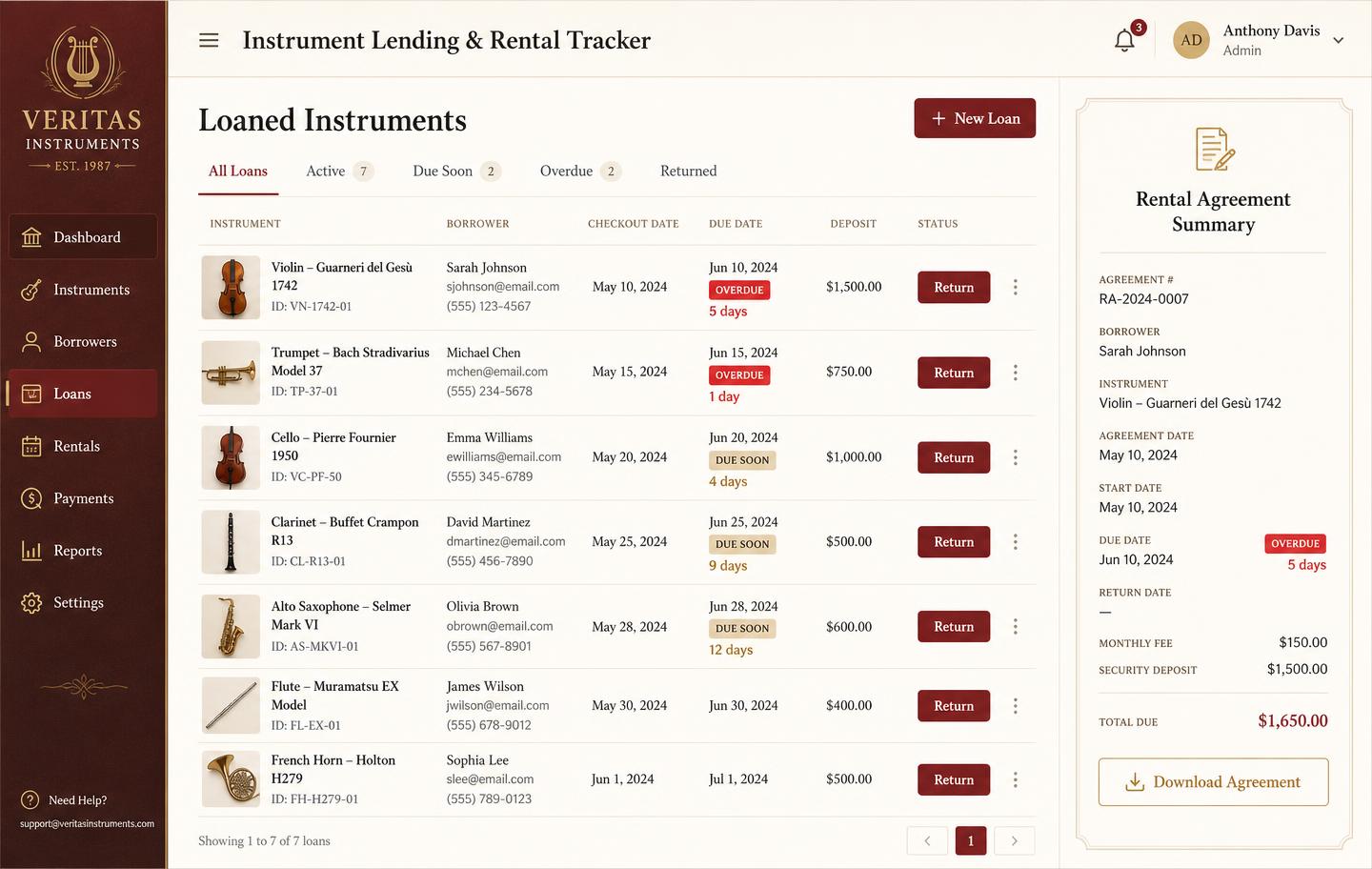
Instrument lending and rental tracker with borrowers, due dates, overdue badges and deposits
Instrument lendingLoans and rentals by unit: who has it, when it is due, what deposit is held, and which agreements are overdue.

Frequently asked

What is music store inventory software?
It is stock management built for one-of-a-kind goods. Instead of counting how many of a SKU you hold, it gives every physical instrument its own record with a serial number, condition grade, cost basis, photographs, and a history that follows it from intake to sale.
Can I import my existing inventory spreadsheet?
Yes. Upload a CSV with a header row and map your columns to serial, condition, cost, price and quantity. Re-import the same sheet later to update prices in bulk rather than editing unit by unit.
Does it track serial numbers per unit?
Yes. Every instrument is its own card with its own serial, condition, photos and history — not a stacked SKU with a quantity beside it.
Can I see total inventory value?
Yes. The dashboard shows live stock value at cost and at retail, and the accounting reports include an inventory valuation snapshot for any period.
Does it handle consignment and trade-ins?
Yes. A unit can be owned, consigned, or taken in part-exchange, with the consignor split and the trade-in allowance recorded against the same record that eventually sells.
What happens when an instrument goes to the repair bench?
Its status changes to in repair and the work order attaches to the unit. The parts and labour become part of that instrument's cost, so the margin you report at sale is the real one.
How much does it cost?
$49 per month flat, with unlimited units and unlimited staff accounts. No per-user fees, no tiers, and no free trial.

Sign up today

Run your shop on one workbench — starting today.

$49/month, no contracts, no trial. Import your spreadsheet, invite your team, and have inventory, repairs, rentals, and lessons in one place tonight.